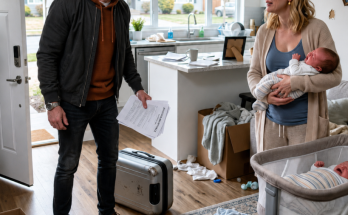
I wasn’t worth the investment.
Ashley was.
That night they left.
No hugs.
No promises.
No tears from my father.
The last thing he said before walking out was:
“Take care of yourself.”
Then he was gone.
My mother followed.
The door closed.
And I never saw them again.
Not for fifteen years.
The first week after they abandoned me felt like drowning.
Everyone kept telling me I was brave.
Strong.
Resilient.
I hated those words.
Strong people weren’t terrified.
Strong people didn’t cry themselves to sleep.
Strong people didn’t spend hours staring at the door hoping their mother would come back.
I did all of those things.
Then Olivia Hart walked into my life.
At first she was simply my nurse.
She checked my medications.
Monitored my vitals.
Brought me blankets when chemotherapy made me cold.
But she also stayed.
Long after she was supposed to leave.
One night she found me awake at three in the morning.
“You should be sleeping,” she said.
“I can’t.”
“Why not?”
I looked away.
“Because if I fall asleep, I dream about them.”
Olivia sat beside my bed.
Neither of us spoke for a while.
Then she asked quietly:
“If they walked through that door right now, what would you say?”
The answer came immediately.
“Why wasn’t I enough?”
The words surprised even me.
Because that was the real question.
Not why they left.
Not why they chose money.
Why wasn’t I enough?
Olivia reached over and squeezed my hand.
“You were always enough.”
I started crying.
Hard.
The kind of crying that hurts.
And she stayed through every second of it.
The chemotherapy lasted months.
Then more months.
Then even more.
Some days were victories.
Some were disasters.
There were infections.
Complications.
Hospitalizations.
Moments when even the doctors looked worried.
But every time I opened my eyes, Olivia was there.
Sometimes with books.
Sometimes with terrible jokes.
Sometimes with milkshakes she smuggled in despite hospital rules.
Always there.
One afternoon, nearly a year after my diagnosis, she appeared carrying a stack of paperwork.
“What’s that?”
She smiled nervously.
“A very big question.”
I frowned.
“What kind of question?”
“The kind that changes everything.”
Then she sat beside me.
And said:
“Emily, how would you feel about coming home with me?”
I stared at her.
“I don’t understand.”
“I’ve filed adoption papers.”
For a second I thought I had imagined it.
“You want to adopt me?”
“Yes.”
“Why?”
The answer came without hesitation.
“Because every child deserves someone who chooses them.”
That was the moment my life changed.
Not when I beat cancer.
Not when I graduated.
Not when I became a doctor.
That moment.
Right there.
When someone looked at a broken thirteen-year-old girl and said:
I choose you.
The adoption became official six months later.
I became Emily Hart.
And for the first time in years, I had a home.
A real home.
Not a hospital room.
Not a foster placement.
Home.
Olivia wasn’t wealthy.
Far from it.
I learned later that she refinanced her house.
Took extra shifts.
Worked weekends.
Sold jewelry that had belonged to her grandmother.
All to keep me healthy.
But she never told me any of that.
Not then.
To me she simply said:
“We’ll figure it out.”
And somehow she always did.
Years passed.
High school.
College.
Medical school.
Every milestone carried the same memory.
The day my parents decided I wasn’t worth saving.
I never forgot.
Not because I wanted revenge.
Because I needed purpose.
Every child I treated deserved someone who would fight for them.
The way Olivia fought for me.
That belief carried me through every exam.
Every sleepless night.
Every impossible challenge.
Until finally, fifteen years later, I stood backstage at Madison Square Garden waiting to deliver the valedictorian address.
And my biological parents sat in the front row.
Waiting to claim credit for a life they had abandoned.
What they didn’t know was that the speech folded inside my jacket pocket wasn’t the one the university had approved.
I had written another version.
One that contained the truth.
Every painful piece of it.
And in a few minutes, the entire arena was going to hear it.
Including them.
I looked out toward the crowd.
My father sat proudly in his seat.
My mother dabbed at her eyes.
Ashley smiled as if she belonged there.
None of them knew what was coming.
Then the coordinator nodded.
“It’s time, Dr. Hart.”
I took a breath.
Stepped toward the stage.
And walked directly into the moment I had been waiting fifteen years to face.
Final Part
The applause thundered through Madison Square Garden as I stepped onto the stage.
Thousands of people rose to their feet.
Families cheered.
Camera flashes lit up the arena like tiny bursts of lightning.
For a moment, I simply stood there.
Not because I was nervous.
Not because I had forgotten my speech.
But because fifteen years earlier, I had sat alone in a hospital bed wondering whether I would survive another month.
Now I was standing here.
Alive.
A doctor.
Valedictorian.
Loved.
I glanced toward the front row.
My biological parents smiled proudly.
My father even straightened his jacket.
Already enjoying the attention.
Already preparing to accept credit.
The Dean handed me the microphone.
“Congratulations, Dr. Hart.”
“Thank you.”
The arena quieted.
I unfolded my speech.
The approved version sat neatly behind it.
The version nobody expected.
I left it there.
Then I looked directly at the audience.
“My name is Dr. Emily Hart.”
More applause.
I waited for it to fade.
“Fifteen years ago, I was not expected to stand here today.”
Silence settled across the arena.
“When I was thirteen years old, I was diagnosed with acute lymphoblastic leukemia.”
People listened carefully.
“My doctors believed I could survive.”
I paused.
“But survival came with a cost.”
Near the front, I saw my mother’s smile begin to weaken.
“My father asked one question.”
I could still hear his voice.
Still remember every word.
“How much?”
A murmur moved through the audience.
“My treatment was expensive.”
I swallowed.
“Too expensive, apparently.”
The arena became completely silent.
“My parents had another child with a college fund worth one hundred and eighty thousand dollars.”
My father’s face froze.
“They decided her future was worth protecting.”
I looked directly at him.
“And mine wasn’t.”
The color drained from both of their faces.
The audience was motionless.
Nobody coughed.
Nobody moved.
Nobody looked away.
“When I was thirteen years old, my parents surrendered custody of me in a hospital room so they would not have to pay for my cancer treatment.”
A shocked gasp swept through the arena.