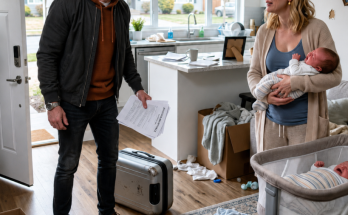
Whitman swallowed hard. “I understand.”
Only then did she let him in.
The apartment was small, but it was full of life. Children’s drawings covered the refrigerator. Tiny sneakers sat beside the door. A cardboard solar system hung from the ceiling near the kitchen table.
There was no expensive art.
No designer furniture.
No silence.
For the first time in years, Whitman understood that a home did not need marble floors to feel rich.
Lillian folded her arms.
“How long have you been looking into my life?”
Whitman looked down. “I saw you at the bakery.”
“So you investigated me?”
“I wanted to know what happened.”
Her eyes sharpened. “No, Whitman. You wanted information. That is not the same thing as caring.”
He had no answer.
Because she was right.
The first thing he had done was not apologize. It was not ask if she was okay. It was not ask what she needed.
He had ordered a report.
Just like she was another property to assess.
Finally, he said the question he could no longer hold back.
“Why didn’t you tell me?”
Lillian’s face changed.
Not with guilt.
With disbelief.
“You really don’t remember, do you?”
Whitman frowned.
She gave a sad laugh.
“Three weeks after our divorce, I found out I was pregnant.”
His chest tightened.
“Lillian…”
She raised a hand.
“No. You need to hear this.”
She walked to the kitchen table and rested one hand on the back of a chair.
“Do you remember the last real conversation we had before everything ended?”
He remembered.
He wished he did not.
They had argued in their old home in Highland Park. Lillian had asked whether he ever saw children in their future.
Whitman had been impatient. Cold. Certain of himself.
He had told her, “I never wanted children, and I never will.”
At the time, he had believed success required sacrifice.
Now he understood that some sacrifices keep bleeding long after the decision is made.
Lillian’s voice trembled, but she did not cry.
“I thought about calling you. I really did. Then I remembered your face when you said you didn’t want a family.”
Whitman whispered, “I was wrong.”
“You were absent,” she said. “There is a difference.”
Then she told him everything.
The difficult pregnancy.
The fear.
The early birth.
The long nights in the hospital.
The bills that arrived after every appointment.
The mornings she went to work after sleeping only two hours.
The way Owen used to ask why other children had dads at school events.
The way Miles once drew a man with no face and said maybe that was his father.
Whitman stood there, listening to the life he had missed.
Every word landed heavily.
When she finished, he said, “Let me fix it.”
Lillian shook her head immediately.
“This is not a building, Whitman.”
“Then tell me what to do.”
Her answer was quiet.
“Do nothing fast.”
Five Minutes in the Hallway

Lillian did not let him meet the boys that night.
Not really.
But after a long silence, she stepped toward the hallway.
“You can see them,” she said.
Whitman looked at her, stunned.
“Only for a minute. They are asleep. You do not speak. You do not touch them. You just look.”
He nodded.
The boys’ room was lit by a moon-shaped nightlight. Owen slept curled under a blue blanket. Miles had one arm wrapped around a stuffed dinosaur, his notebook open beside him.
Whitman lowered himself to one knee.
His sons.
Not names in a report.
Not a mistake from the past.
Real children.
His children.
Owen had the same small crease between his eyebrows that Whitman had carried since childhood. Miles had Lillian’s gentle hands, resting open as if he had fallen asleep while reaching for a dream.
Whitman covered his mouth with one hand.
For years, he had believed he was building something important.
But here, in a small apartment bedroom, he realized he had missed the most important construction of all.
A family had been built without him.
And it was beautiful.
When they returned to the living room, Whitman’s voice was barely above a whisper.
“Do they know about me?”
Lillian looked toward the hallway.
“They used to ask.”
The words hurt.
“And now?”
She looked back at him.
“Now they ask less.”
That answer hurt even more.
Children do not stop asking because the question becomes less important.
They stop because waiting becomes too painful.
Whitman nodded slowly.
“I want to earn a place.”
Lillian studied him carefully.
“Then start small.”
“Anything.”
“Their school has a family science night next Friday. You may come.”
Hope rose in him so quickly it almost scared him.
Then she added, “Not as their father. Not yet.”
He nodded.
“No expensive gifts. No dramatic entrance. No reporters. No trying to impress anyone.”
“I understand.”
“Just show up.”
For once, the instruction sounded harder than any business deal he had ever closed.
Because showing up meant more than standing in a room.
It meant returning.
Again and again.
Even when it was uncomfortable.
Even when he was not welcomed with open arms.
Even when nobody applauded him for doing what he should have done years ago.
As he reached the door, Lillian said one last thing.
“Biology may explain who you are to them, Whitman. But it does not prove what you will become.”
He turned back.
Her eyes were tired, but steady.
“Being a father is not a title you claim. It is a promise you live.”
The Night He Finally Showed Up