“Aaron, you cannot do this to us. Wells Fargo sent a late notice. Your father’s medication card was declined. This is our home.”
“Then you should protect it with your own money.”
My father swore under his breath.
“All this over some dishes?”
“No,” I said. “This is about my daughter.”
My mother began crying, but the sound felt less like grief than strategy.
“We are sorry if she felt upset. She misunderstood discipline.”
“She understood perfectly. You taught her that your love has a blood test attached.”
My father’s anger hardened.
“Do not compare that girl to Madison and Chloe.”
There it was again. That girl.
I leaned back and looked toward Emma’s closed bedroom door.
“You will never speak about my daughter that way again.”
“Your daughter?” he snapped. “You mean the child you picked up from the state because you were lonely?”
The words were meant to wound me.
They did not.
They clarified him.
“Do not call again asking for money.”
My mother shouted my name before I ended the call.
I blocked both numbers.
The following week, Melissa called from a different number and began with accusation rather than greeting.
“Do you realize what you are doing to Mom and Dad?”
“Yes.”
“They could lose the house.”
“That would be the bank enforcing a loan they signed.”
She laughed bitterly.
“You have always been dramatic about that adoption because deep down you know it is not the same.”
I remained very still.
“Say that again.”
She took my silence as invitation.
“Mom and Dad only meant that you have responsibilities to your real family too. You act as though Emma is the same as a biological child, but everyone knows there is a difference. Madison and Chloe are their actual grandchildren.”
I looked at a drawing Emma had taped to the refrigerator: two stick figures holding hands beneath a crooked sun.
“You are no longer welcome in my life.”
“Aaron, do not be absurd.”
“Goodbye, Melissa.”
I blocked her too.
Two months later, a cousin I barely knew sent a text saying my parents had been served foreclosure papers and that I should be ashamed. I deleted it. Another relative wrote that children owe their parents support. I replied once.
“Parents who harm my child are not entitled to my resources.”
Then I stopped explaining.
Part Three: The Night They Came To My Door

The eviction happened in January, during the coldest week Indiana had seen in years. I learned about it from Melissa, who sent a furious message through email because every other route to me had been blocked. The bank had auctioned the house, the sheriff had supervised removal, and my parents were sitting in her driveway with bags because her husband refused to let them stay longer than one night.
I read the email twice.
Then I made dinner for Emma.
I thought the matter would remain distant until the doorbell rang at nine fifteen.
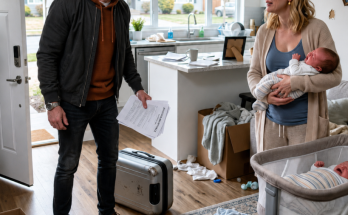
Emma was on the couch under a pink blanket watching a movie. I opened the door and found my parents standing in the hallway of our apartment building, older than I remembered, damp from snow, carrying two duffel bags and the brittle dignity of people who had never imagined consequence would feel so physical.
My mother began crying immediately.
“Aaron, please. We have nowhere else.”
My father stared at the floor.
“Just until we find somewhere. A few weeks.”
For one second, instinct nearly betrayed me. I saw my mother’s wet hair, my father’s shaking hands, and the old training rose inside my chest: bring them in, make coffee, fix what others broke, become the good son again.
Then Emma’s laugh floated from the living room.
The sound steadied me.
I stepped into the hallway and pulled the door almost closed behind me.
“You cannot stay here.”
My mother looked stunned.
“We are your parents.”
“And Emma is my child.”
My father lifted his head then, his face twisting with humiliation.
“We apologized.”
“You apologized because you lost the house.”
“What do you want from us?” my mother pleaded.
“Nothing anymore.”
The truth of that surprised even me. I had spent years wanting them to change, wanting them to see Emma, wanting them to bless the family I had chosen. Now I wanted only distance.
My mother lowered her voice.
“Are you truly going to leave your own parents outside in winter because of a child who is not even—”
I raised one hand.
“Finish that sentence, and it will be the last thing you ever say to me.”
She stopped, but her expression revealed that the sentence lived in her unchanged.
My father muttered, “Melissa cannot take us. Her house has no room.”
A humorless smile touched my mouth.
“The real grandchildren have no spare room for you?”
Neither answered.
I wrote down the address of a county emergency shelter and handed it to my father.
“They have intake until midnight. I called last month after the foreclosure notice, because unlike you, I plan for people I am responsible for.”
My mother stared at the paper as though it were an insult.
“A shelter?”
“Yes.”
“After everything we did for you?”
I thought of Emma at the sink.
“After everything you did, yes.”
I went back inside before guilt could dress itself as mercy.
Emma was standing near the couch, holding her blanket.
“Was that Grandma and Grandpa?”
I could have lied. For years, I had watched adults use lies to make children carry less reality but more confusion. I refused.
“Yes.”