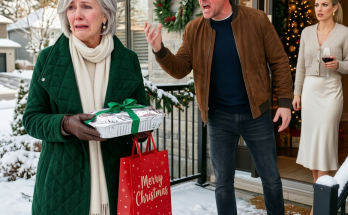
She thought she had won.
She even leaned toward Audrey and whispered, not nearly softly enough, “Once we’re inside, we’re not leaving.”
Nolan cracked his knuckles.
I heard her.
So did the officer.
I opened the gate from my phone.
The iron panels moved inward with a slow mechanical hum, and Cynthia rushed forward before they had even fully opened. Audrey followed with her phone in hand. Nolan barked at the movers, “Be ready. We’re unloading today.”
I said nothing.
I walked behind them through the garden, past the ivy, the empty fountain, and the stone steps leading to the double front doors.
Nolan reached the entrance first and pushed it open.
“We’re in,” he called.
Then his voice vanished.
Cynthia crossed the threshold and stopped so suddenly that Audrey bumped into her back.
“What in the world…”
Then they all saw it.
Nothing.
The foyer was empty.
No marble console. No antique mirror. No Persian rug. No chandelier. No framed photographs. No fresh flowers in the silver bowl Cynthia had always claimed made the house “feel civilized.” There were only polished floors, pale walls, and the echo of their breathing.
Nolan ran into the living room.
“Where is everything?”
The great room, once filled with deep sofas, walnut shelves, art pieces, lamps, and the enormous curved television Preston loved to stand beside during video calls, was bare from wall to wall. Afternoon sun poured through the windows and stretched across the floor, bright and indifferent.
It was not minimalist.
It was empty.
Cynthia moved through the room as if she had entered the wrong house.
“Claire, what did you do?”
Audrey hurried into the kitchen and began opening cabinets.
“There’s nothing in here. There isn’t even a refrigerator.”
Nolan thundered upstairs. His footsteps echoed above us, frantic and heavy.
“The bedrooms are empty,” he shouted. “The closets too.”
Cynthia turned back to me, her face pale beneath her perfect makeup.
“You stole the furniture.”
“No,” I said. “I sold my furniture. Every item in this house was bought by me, invoiced to me, insured by me, or inherited by me. Preston’s personal belongings are in the garage, boxed and labeled. His clothing is in four containers. His golf clubs are beside the door. His expired protein powder is also there, unfortunately.”
Someone outside laughed.
Cynthia’s hands curled at her sides.
“You spiteful little—”
“Careful,” the officer said.
Audrey returned from the kitchen looking genuinely unsettled.
“There’s no stove. No dishwasher. No appliances. How is anybody supposed to live here?”
I tilted my head.
“That sounds like a question for someone who planned to live here without permission.”
That was when Cynthia’s face truly changed. Not because she was embarrassed, although she was. Not because the neighbors were watching, although they were. She looked shaken because, for the first time, the fantasy she had carried for years had failed to become reality.
She had imagined my main bedroom becoming hers. She had imagined luncheons by the pool, Audrey filming in the closet, Nolan using the study, Preston returning whenever he pleased, the family name stretched comfortably across property they had never earned.
To them, my divorce had not been the end of a marriage.
It had been moving day.
But the house gave them nothing.
Only space.
Only heat.
Only the sound of their own entitlement coming back at them.
Then Audrey began fanning herself.
“Why is it so warm in here?”
Nolan jabbed at the thermostat.
“It’s not turning on.”
Audrey opened the kitchen faucet. The pipes gave a dry cough and nothing more.
“Is there no water?”
Cynthia stared at me.
“What did you do to the utilities?”
“I canceled them,” I said. “I don’t live here anymore. Electric, water, cable, internet, all of it. The property is being renovated.”
Nolan looked more offended by that than by the legal documents.
“There’s no internet?”
For some reason, that hit Audrey hardest.
“No Wi-Fi?”
I almost smiled.
“No Wi-Fi.”
And there, inside a multi-million-dollar house with no furniture, no appliances, no water, no air conditioning, no internet, and no legal right to stay, the Vale family’s beautiful little plan began to melt.
The Price of Waiting

The movers became the next problem Cynthia had not considered. They had been sitting outside for nearly three hours, and working men with trucks do not generally appreciate being hired into a family fantasy without payment. Their foreman, a large white-haired man named Hank Porter, walked up to Cynthia with a clipboard and asked whether they were unloading or heading back.
Cynthia waved him off.
“Not today. We’ll reschedule.”
Hank looked at her as if she had just asked the sun to reschedule sunset.
“Ma’am, the contract covers two trucks, crew time, waiting time, return mileage, and canceled unloading. Total comes to forty-eight hundred dollars.”
Cynthia gave a dry laugh.
“For doing nothing?”
“For showing up because you told us to,” Hank replied.
Nolan tried stepping toward him.
“You don’t want to push us.”
Hank looked at him once, slowly, and Nolan’s confidence thinned like cheap paper.
The officer explained that the moving bill was a civil matter, but the contract appeared valid. Cynthia eventually opened a small designer purse and counted out payment with hands that trembled more than she wanted anyone to notice. Each bill seemed to hurt her.
That interested me.
Cynthia dressed like money. Gold bracelets, oversized sunglasses, expensive handbags, shoes that clicked across stone like punctuation marks. But much of it was performance. Preston had been moving funds to his family for months before the divorce, not as gifts but as hidden transfers from accounts Caroline had already begun tracing. My attorney called it “a pattern worth discussing in front of a judge,” which was Caroline’s polite way of saying Preston had been careless with his own arrogance.
When the movers finally drove away with Cynthia’s furniture still inside the trucks, Nolan discovered that his SUV had been immobilized. He had parked half of it on my lawn, because to a Vale, rules were suggestions whenever the grass looked nice enough. My private security company had placed a bright yellow lock on one wheel and a notice under the windshield wiper.
“This is my brother’s house,” Nolan shouted.
The officer, now visibly tired, said, “No, sir. It is not.”
I explained that the release fee was twelve hundred dollars, plus damages to the lawn and an additional charge if the vehicle remained overnight.
Nolan kicked the tire lock, then immediately grabbed his foot and hopped backward.
Audrey stood by the curb, near tears because her phone battery was down to three percent. Cynthia sat on the edge of the sidewalk with the broken dignity of a queen who had misplaced her country.
At 7:42 that evening, Preston’s black Mercedes turned onto the street.
He stepped out with his tie loosened and fury arranged across his face like a mask he had practiced in mirrors. Cynthia rushed toward him, talking so fast that even he seemed unable to follow. He looked at the empty curb where the moving trucks had been, Nolan’s immobilized SUV, Audrey holding a powerless phone, his mother seated in front of neighbors she had hoped to impress, and finally at me standing behind my gate.
Then he opened the trunk and took out a baseball bat.
Curtains moved along the street.
Audrey whispered, “Preston, don’t.”
He ignored her and struck the gate once, hard enough to make the iron ring.
“Claire, open this gate before I take it down.”
I lifted my phone, started recording, and began a live stream.