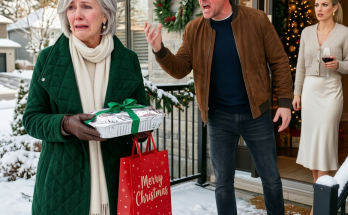
Valerie clutched a bag to her chest.
“I’m only coming for Mom’s documents.”
“You go in alone. No shouting. Don’t touch anything of Mateo’s.”
She walked in, looking at the walls as if they had become alien to her.
In the hallway, she stopped in front of the laundry room. The door was ajar. Inside, it smelled of bleach, humidity, and cheap soap. In a corner, I had found Mateo’s small blanket the night before, folded over a bucket.
Valerie saw it.
For the first time, her face broke.
“I didn’t know she left him here so long.”
“You didn’t want to know.”
“Clara…”
“No.”
I turned away before her sisterly voice could weaken me.
She took documents from a drawer and, as she closed it, found a sheet of paper taped from the inside. It was a drawing by Mateo. A small red house, a sun, and three figures: him, me, and a man with wings.
Underneath it read: “When I grow up, I’m going to buy a door that actually opens.”
Valerie sat on my mother’s bed.
She didn’t cry loudly.
She just stared at the drawing as if it had struck her.
“Damian didn’t want breakfast,” she whispered. “He says he’s bad.”
“Tell him he’s not bad. Tell him he did bad things because adults allowed him to. You can still save him from becoming like you.”
Her eyes filled with tears.
“And me?”
I didn’t answer immediately.
Because a part of me still remembered the little girl Valerie, sharing a hidden lollipop with me on the roof.
But that little girl had grown up.
And she had chosen to look the other way.
“You have to save yourself.”
That afternoon, I took Mateo for a check-up and then for chicken broth at the market. He chose a mosaic gelatin and ate it slowly, being careful of the injured side of his face. On the way back, we passed through the street market.
At a used toy stall, he saw another car, a yellow one, with a crooked wheel.
“Should we buy it?” I asked.
Mateo shook his head.
“No. The red one is fine. It was just with the wrong person.”
I stood in the middle of the aisle, between clothes stalls, the smell of street food, and the shouting of vendors.
My six-year-old son had just understood what it took me thirty-two years to learn.
That something valuable doesn’t stop being valuable just because someone treats it poorly.
Three months passed.
The process remained slow, like almost everything that goes through desks and stamps. But our lives were no longer on hold.
Mateo turned seven in the patio.
I hung paper banners, made hibiscus tea, and bought a tres leches cake because it was his favorite. He invited two school friends, Mrs. Lucha, the doctor who treated him that night, and the social worker.
He also invited Damian.
I didn’t say anything when he handed me the list.
“Are you sure?”
“Yes,” he said. “But if he takes anything, he’s gone.”
I smiled.
“Deal.”
Damian arrived with a gift wrapped in newspaper. It was a handmade wooden car, painted red, but with a yellow stripe.
“I made it with my grandpa,” he said. “It’s not to replace the other one. It’s so he has a friend.”
Mateo received it carefully.
“Thanks.”
They didn’t hug.
They didn’t need to.
Sometimes repair begins with two children playing without any adult teaching them to hate.
Mid-afternoon, when everyone was singing “Las Mañanitas,” I saw my mother on the other side of the gate.
She was older.
Smaller.
She was wearing a brown sweater and a shopping bag. She didn’t knock. She just watched.
My body tensed.
Mateo saw her, too.
The music continued, but for me, everything went silent.
My mother raised a hand.
I didn’t know if she was greeting or asking for permission.
For the first time, I didn’t run to interpret her pain.
I didn’t open the door.
I didn’t scream.
I didn’t insult her.
I just stood between her and my son.
Mateo took my hand.
“Can she come in?” he asked quietly.
I crouched to his level.
“That decision is not for you to carry.”
“And for you?”
I looked at the woman who had birthed me and the boy I had sworn to protect.
“Yes, it is.”
I went up to the gate.
My mother had moist eyes.
“Clara… I just wanted to see him from afar.”
“You’ve seen him.”
“He is my grandson.”
I took a deep breath.
“No. He is Mateo. And his name is said in full.”
She swallowed hard.
“Mateo,” she repeated, as if the word scraped her tongue.
For a second, she almost looked repentant.
Almost.
But I no longer lived on “almost.”
“Someday, if the specialists say it is safe and if he wants to, maybe you can write him a letter. Without blame. Without demands. Without calling yourself a victim.”
My mother cried.
“And you? Will you never forgive me?”
I looked toward the patio.
Mateo was blowing out the candles. His friends were clapping. Damian was jumping beside him. The house was full of light, not fear.
“I have let you go, Mom,” I said. “Do not confuse that with opening the door for you.”
I closed the gate.
This time, the metal didn’t sound like punishment.
It sounded like a boundary.
I went back to the patio and Mateo ran toward me with his mouth stained with frosting.
“Mom, did you make a wish?”
“It wasn’t my birthday.”
“Make one anyway.”
I hugged him tight, being careful not to hurt any wounds, because some were still healing on the inside.
I closed my eyes.
I didn’t ask for money.
I didn’t ask for revenge.
I didn’t ask for the past to disappear.
I asked that my son never again ask me if he deserved a blow.
When I opened my eyes, Mateo placed the red car on the table, next to the new one. He arranged them in front of the cake, as if they were two guardians of a small kingdom.
“Dad came, too,” he said.
I looked at the house.
Our house.
The roof Julian left.
The refuge I learned to defend.
And for the first time in many years, I didn’t feel ashamed of being there.
I felt rooted.
I felt strength.
I felt that the girl I was, the widow who trembled, and the mother who carried her bleeding son to the hospital were hugging each other inside me.
The family had pretended not to see the blood.
But I saw it.
And from that night on, I never looked away again.