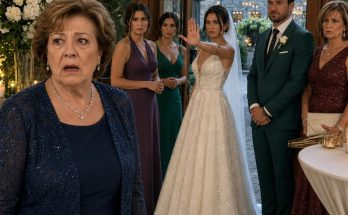
So what was this $74,000?
I called Vivien Tate, the owner of the Hollander estate and an old friend. She told me the truth. On the morning of the wedding, Joselyn’s mother, Margot Hartwell, had added a champagne tower, upgraded meals, premium bar extensions, a larger orchestra, extra floral installations, and a late-night dessert station. By the reception, the total had reached $74,000.
When Vivien asked Bryce for payment, both of his cards declined.
Then Vivien told me something else. The Hartwells were not as wealthy as they pretended to be. Stanford Hartwell, Joselyn’s father, owned a struggling commercial real estate business. Refinances, vendor disputes, weak banking relationships—the family was sliding financially while still throwing parties like they were at the top.
Vivien called it a comeback wedding.
A family falling from status throws one huge event to convince everyone they are still powerful.
And they had expected me to fund it.
Then my daughter Renee called. She was twenty-four weeks pregnant and told me Bryce had asked her to “lean on me” about the bill. He had not asked about the baby. He had only wanted help pressuring me.
That was the moment I began to understand that this was not just about a wedding bill.
It was about being used.
And it had started long before the wedding.
PART 3: The Call That Changed Everything
I called my attorney, Russell Pike, who had been Theo’s college roommate, our longtime lawyer, and the closest thing my children had to a father figure after Theo died.
When I mentioned Stanford Hartwell, Russell went quiet.
Then he told me something I was not prepared to hear.
Five months before I ever met Stanford, Hartford Heritage Bank had called Russell to verify my signature on a $1.2 million commercial loan application for Hartwell Reston Commercial Real Estate. Stanford had listed me as a co-signer.
The signature was not mine.
Russell had caught it, warned the bank, and Stanford had withdrawn the application, claiming it was an administrative mistake.
In that moment, everything became clear. The Hartwells had not simply wandered into my son’s life. They had moved toward it. My name, my credit, my company, my reputation—they had seen all of it as a rescue plan.
A few days later, I called Bryce.
“Put me on speaker,” I said. “Joselyn should hear this too.”
Then I told them four things.
First, I had paid $185,000 for their wedding venue as a gift.
Second, the $74,000 was not the venue bill. It was Margot’s same-day upgrades.
Third, Stanford Hartwell had tried to use my name on a commercial loan application without my permission, and my attorney had the documents.
Fourth, I was done.
I told Bryce I was removing myself as guarantor from his New York apartment. I canceled the $50,000 gift transfer scheduled for November. I removed him from the Maxwell and Lyall succession plan before the Aspenwood closing. Renee remained where she had always belonged.
Bryce cried and said I could not do this.
I told him I was not punishing him. I was simply leaving the way Joselyn had asked me to leave at the door of the venue. Only this time, I was leaving everywhere.
Joselyn’s voice changed after hearing the truth. She said she had not known about her father. I believed her.
But belief did not mean I would stay involved.
I told Bryce I loved him and always would. If he had children one day and wanted me in their lives, I would be there. But I would not fund his marriage to a family that had planned to use me before they even met me.
Then I said goodbye.
Months later, Aspenwood bought my company for $4.2 million. Renee gave birth to a son and named him Theo. Stanford’s financial lies eventually collapsed into legal trouble. Joselyn filed for divorce after discovering more forged signatures. The Hartwell family lost their house, their status, and the careful image they had spent years protecting.
Bryce sent me four messages over six months. I read them once and archived them in a folder called Later.
One day, I may be ready to talk to him.
Not yet.
The cufflinks are still in the leather box in my drawer beside Theo’s watch. Bryce’s name is still engraved on the back.
I did not change that.
Maybe one day he will become the kind of man who can wear them and understand what they cost.
Not in money.
In everything else.
Until then, they wait.