But it was not hers.
Not legally.
Not completely.
And tonight, in front of twenty-three witnesses, she had done the one thing that could activate the clause.
My phone buzzed again.
This time from my company’s CFO, Adrian Wells.
Mrs. Alden, sorry to text so late. Natalie sent instructions tonight for executive account transfers effective Monday. I wasn’t aware of a leadership change. Should I process anything?
My body went still.
Account transfers.
Tonight.
Before the dinner was even over.
I typed with trembling fingers.
Process nothing. Freeze all non-routine transfers. Call Miriam Clarke first thing in the morning. Confidential.
Adrian replied immediately.
Understood. Are you safe?
That question broke something inside me.
Are you safe?
Nobody downstairs had asked that.
Not my granddaughter.
Not her husband.
Not the guests.
My CFO had shown more concern for me than the child I raised.
I answered.
I will be.
Part 3: The Clause Wakes Up
At 12:17 a.m., I called Miriam.
She answered on the fourth ring, her voice thick with sleep but instantly alert when she heard mine.
“Beatrice?”
“I need you.”
“What happened?”
I tried to stay calm, but when I said, “Natalie hit me,” my voice cracked.
Miriam did not waste time.
“Are you injured?”
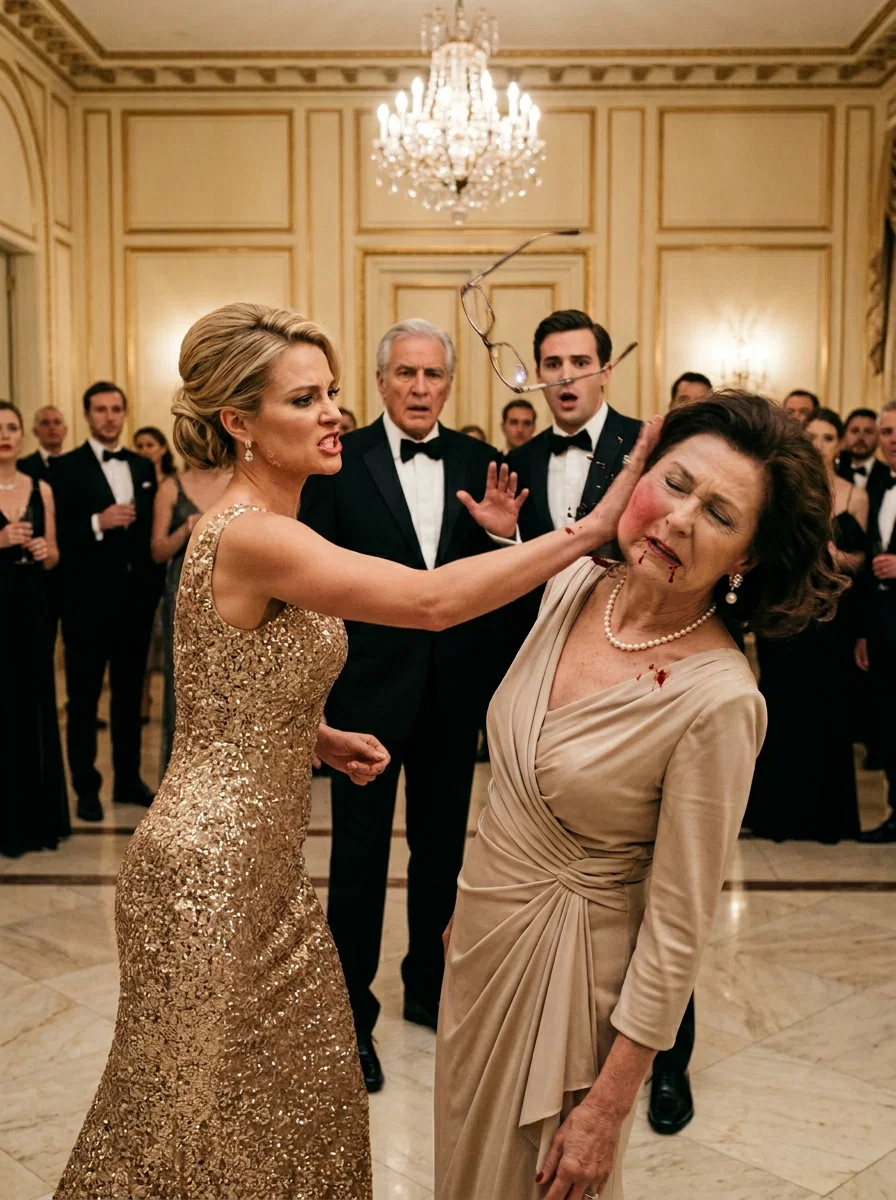
“My lip is split. My glasses broke. There were witnesses.”
“Photograph everything. Do not wash the blouse. Do not clean any blood. Do not respond to Natalie except to say you need space.”
“She announced she was taking over the company.”
“Did you authorize that?”
“No.”
“Did the board?”
“No.”
“Did she attempt transfers?”
“Yes. Adrian caught it.”
A pause.
Then Miriam’s voice turned cold.
“The contingency clause may now be active.”
“I know.”
“Are you prepared for what that means?”
I looked toward the bedroom door.
Downstairs, Natalie’s voice rose again, angry and embarrassed.
I thought of the little girl with braids.
The teenager who cried in my lap after her first heartbreak.
The young woman who wore Clara’s veil at her wedding.
Then I thought of her hand across my face.
You should have died years ago.
“Yes,” I said. “I am prepared.”
At 1:05 a.m., I took photographs.
My lip.
My broken glasses.
The blood on my blouse.
The sideboard where my shoulder struck the corner.
The place cards left on the dining room table after everyone finally left.
My original card at the head of the table had been scratched out in Natalie’s handwriting.
A new card had been placed near the kitchen door.
Beatrice.
Not Grandma.
Not Mrs. Alden.
Beatrice.
A small paper demotion.
At 1:42 a.m., I found the second secret.
In my company email was a draft resolution prepared by Graham’s attorney.
Resolution to Remove Beatrice Alden as Active Chair Due to Cognitive Decline.
Cognitive decline.
I read the phrase twice.
The document claimed I had increasing confusion, emotional instability, and difficulty managing corporate matters. It recommended appointing Natalie as interim CEO and Graham as strategic advisor with signing authority over expansion funds.
Expansion funds.
Twenty-two million dollars in emergency reserves.
Money meant to protect authors, staff salaries, printing contracts, and the future of Alden House Books after I was gone.
At the bottom was a list of proposed supporting statements from “concerned family and colleagues.”
Several dinner guests were named.
They had not come to celebrate me.
They had come to observe me.
To provoke me.
To witness my reaction.
Tonight had not only been humiliation.
It had been evidence gathering.
Natalie wanted me emotional.
Shaking.
Unstable.
The slap had not been the plan.
But the trap had been.
For one minute, I could not move.
Then I began to laugh softly.
Not with joy.
With grief.
Natalie thought cruelty made me weak.
She forgot cruelty also clarifies.
By sunrise, Miriam was at my kitchen table.
So was Adrian, pale and furious.
Mrs. Bell sat beside me with untouched tea. She had seen the slap, heard Natalie’s speech, and she was willing to say so.
Miriam spread the documents across the table.
Photographs.
Emails.
The draft resolution.
The attempted account transfers.
Screenshots of Natalie’s texts.
Medical photos of my injury.
The trust clause.
“This is worse than I expected,” Miriam said.
Adrian looked sick.
“She tried to schedule reserve transfers for Monday. Three accounts. Different entities.”
“Controlled by whom?” Miriam asked.
Adrian hesitated.
“Graham.”
The room went silent.
So that was the shape of it.
Natalie wanted the title.
Graham wanted the money.
And I was the old woman standing between them and everything they had already spent in their minds.
By nine o’clock, Natalie’s company email was locked.
By nine fifteen, her agency funding was frozen.
By nine thirty, her corporate cards were canceled.
By ten, the board was notified that any leadership transition was fraudulent and unauthorized.
By ten twenty-two, Natalie called me thirty-seven times.
I did not answer.
At eleven, she came to my front door.
I watched from upstairs as she stormed up the walkway in sunglasses, hair perfect, mouth tight with rage.
Graham followed behind her.
Miriam stood beside me.
“Do you want to speak with them?”
“No.”
“Good.”
Mrs. Bell had already called a security company.
Adrian had already arranged a forensic audit.
Miriam had already prepared the letter that would change Natalie’s life before lunch.
The doorbell rang.
Then Natalie pounded on the door.
“Grandma! Open the door!”
I flinched.
Grandma.
Now she remembered.
Miriam opened the door with the chain still latched.
“Your conditional trust benefits are suspended,” she told Natalie. “Your executive access is revoked pending investigation. Your agency funding is frozen. You are barred from entering company offices without written authorization.”
Silence.
Then Natalie said, smaller now, “You can’t do that.”
“She can,” Miriam replied. “And she did.”
Graham snatched the papers.
Then his voice changed.
“Natalie…”
“What?”
“This includes the Palisades house.”
Yes.
The house.
The down payment had come from the trust, structured as conditional support, not a gift. Miriam had insisted.
I had resisted.
Now her foresight felt like a hand pulling me out of a grave.
“You are not to sell, refinance, transfer, borrow against, or encumber the property,” Miriam said.
Graham cursed under his breath.
That was when I understood.
They had already tried.
I stepped away from the banister.
Not because I was afraid.
Because I no longer needed to stand at doors waiting for people to choose decency.
They had chosen.
Now I would choose too.
Part 4: The Boardroom Reckoning
The first week was brutal.
Natalie flooded the family with messages saying I was unstable. Graham told investors I was having “an episode.”
Several dinner guests suddenly claimed they had not seen the slap clearly.
One said I tripped.
Another said I had been aggressive first.
But Mrs. Bell told the truth.
So did the caterer.
So did a young agency intern Natalie had invited to make herself look important.
Then Adrian found the records.
Three months of emails between Natalie, Graham, and a consultant who specialized in “succession narratives” for family businesses.
Succession narrative.
That was what they called my erasure.
The emails discussed making me appear emotionally erratic. Encouraging me to make a scene in front of credible witnesses. Using my age, grief, and occasional forgetfulness as leverage.
One email from Graham made my blood turn cold.
The old woman won’t step down unless she is cornered. Natalie needs to stop thinking of her as Grandma and start thinking of her as the asset blocker.
Asset blocker.
Not mother.
Not elder.
Not woman.