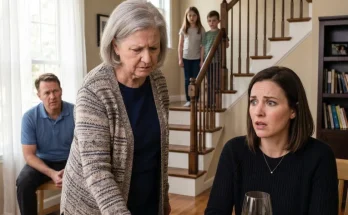
The call came on a Tuesday morning, slicing cleanly through the fragile peace I
had spent the last three months carefully constructing. I was sitting at the
massive oak island in my father’s kitchen, a cup of black coffee steaming in my
hands, watching the early sunlight lean across the original hardwood floors in
soft, golden bars.
When Eleanor’s name flashed across my phone screen, the air in the room seemed
to drop ten degrees.
Nothing that came from Eleanor was ever pleasant, nor was it ever without an
angle. She did not call to connect, to grieve, or to check in. She called to
establish dominance. She called to remind people of the version of reality she
preferred—the one where she was the undisputed matriarch, the center of gravity,
and everyone else was either a useful asset or an obstacle to be cleared.
I let the phone ring one extra beat. I took a slow, deliberate sip of my coffee,
feeling the heat anchor me, and answered with a voice I had practiced cooling
into absolute neutrality.
“Hello, Eleanor.”
“I’ve sold the house,” she announced. No greeting. No context. Not even the
faintest pretense of courtesy. Her tone held that familiar, glossy satisfaction,
rich and impenetrable as fresh lacquer. “The papers are signed, and the new
owners move in next week. I hope you’ve learned your lesson about respecting
your elders, Harper.”
For three full seconds, I said nothing at all.
My name is Harper Sterling, and the house Eleanor was so smugly discussing was
my childhood home. It was a sprawling, Victorian-craftsman hybrid with a
wraparound porch, a breathtaking stained-glass landing window, a deep claw-foot
tub upstairs, and a creaking back staircase that my father, Arthur, swore was
the soul of the architecture. It was the house where I had learned to read by
the fireplace, where I had once hidden under the mahogany dining table during a
thunderstorm while Dad pretended the sky was just rearranging its heavy
furniture.
It was also, according to Eleanor’s latest performance, a house she believed she
had just effortlessly ripped from my hands.
“The house?” I repeated, carefully keeping the dark, bubbling amusement out of
my voice. “You mean Dad’s house?”
“Don’t play dumb with me, Harper. You know exactly which house. The one you’ve
been squatting in rent-free since your father passed. Well, that little vacation
ends now. I found cash buyers. A lovely couple from out of state who will
actually appreciate the property and bring it into the twenty-first century.”
I lifted my mug again, letting her voice wash over me as my mind drifted to a
memory from just days after my father’s funeral. It was a quiet, highly
confidential meeting in a downtown high-rise with my father’s attorney, Benjamin
Vance. Eleanor had absolutely no idea about that meeting. She had no idea about
the thick manila folders, the notarized signatures, the irrevocable trusts, and
the iron-clad legal precautions my father had quietly arranged long before she
ever imagined she had him entirely figured out.
She had spent five years underestimating me. It had simply never occurred to her
ego that my father might have been doing exactly the same thing to her.
“That’s interesting,” I said smoothly. “And you’re entirely sure everything is
legal?”
She scoffed. Through the receiver, I could hear her moving—probably pacing the
expensive rugs of her rented luxury condo, probably smiling that sharp,
carnivorous smile she wore when she believed she was about to humiliate someone
publicly.
“Of course it’s legal, you insolent girl,” she snapped. “I am his widow. The
deed was in his name. You may have been his precious, over-coddled daughter, but
I have spousal rights. Maybe next time you’ll think twice before questioning my
authority regarding the remodeling.”
And there it was. The bruised ego. The real reason for her urgency.
Three months earlier, while my father was barely cold in his grave, I had
physically stood in the foyer and stopped Eleanor’s contractors from gutting the
historic features of the house. My father had spent two decades restoring it.
The hand-carved banisters. The original parquet flooring. The stained-glass
panels he had cleaned with a toothbrush, piece by piece, during a blizzard in
’98. Eleanor had wanted to rip it all out. She wanted sleek open shelving, gray
laminate, chrome fixtures, and bright, soulless lighting that would have made a
century-old home feel like an overpriced dermatologist’s waiting room.
I had looked her in the eye and told her no. She had never forgiven me for the
embarrassment of being dismissed in front of hired help.
“I see,” I said, tracing the rim of my mug. “Well, I hope you got a good price
for it.”
“Don’t you worry about the numbers,” she hissed. “Just make sure your bags are
packed and you are out by next Friday. Leave the keys on the kitchen island. The
new owners are eager to start their demolition.”
“Thanks for the heads-up,” I said. “Goodbye, Eleanor.”
When I hung up, I set the phone down and let out a laugh that echoed off the
high ceilings. It wasn’t a humorous laugh. It was the sound of a perfectly
designed trap snapping shut. Eleanor believed quiet always meant surrender. She
never understood that some of us go still not because we are beaten, but because
we are calculating the exact angle to slip the knife.
I picked up my phone and dialed Benjamin Vance. He answered on the second ring,
his voice warm, rich, and entirely unhurried, as though he had been sitting at
his desk waiting for this specific call all morning.
“Harper,” Benjamin said. “I was beginning to wonder how long her patience would
hold out.”
“She did it,” I told him, looking out the window at my father’s prized rose
garden. “She actually signed papers to sell the house.”
A small note of dry, professional amusement entered his voice. “Did she now?
Well, the audacity is almost commendable. Shall we set the dominoes in motion?”
“Yes, please,” I said. “And Benjamin? Make sure the buyers’ attorney understands
exactly what happened. I don’t want innocent people losing their escrow money
caught in Eleanor’s web.”
“Already planned,” he assured me. “I’ll contact their representation
immediately. Give it a few hours.”
I hung up, feeling a strange mixture of triumph and profound sorrow. I stood up
and began to walk through the house. My fingertips drifted over walls my father
had plastered himself, over the built-in library shelves he had reinforced
because he knew I would collect too many heavy, hardback books.
Every room held his ghost. But as I reached the top of the stairs, a heavy,
rhythmic knocking suddenly echoed from the solid oak of the front door. It was
too soon for it to be Eleanor. It was too aggressive to be a delivery.
I walked back down the stairs, my heart suddenly accelerating. Through the
frosted glass of the sidelights, I could see the silhouette of a man in a dark
suit. I unlocked the deadbolt and pulled the door open.
It was a process server. He held out a thick manila envelope. “Harper Sterling?
You’ve been served.”
I took the envelope, tearing it open as he walked away. It wasn’t about the sale
of the house. It was a petition filed by Eleanor to freeze all of my personal
bank accounts, claiming I was embezzling from the estate. She wasn’t just trying
to take the house; she was trying to financially suffocate me before I could
fight back.
The war hadn’t just started. It had escalated.
The rest of the morning was spent in Dad’s study, surrounded by the scent of old
paper and cedar. I ignored the frozen bank accounts for the moment—Benjamin
would handle that judicial overreach by the afternoon—and focused on sorting
through old photographs.
Eleanor had married my father five years ago, when I was twenty-four. In those
early months, she was an absolute masterclass in soft edges and warm concern.
She was all perfectly timed compliments, delicate laughter, and carefully
practiced kindness. She called me “sweetheart” in front of his colleagues. She
baked him low-sugar desserts.
But once the wedding ring was secured and the daily grind of life no longer
required her to charm the room, the cracks began to show. A comment about how
“unnaturally close” Dad and I were. A suggestion that it was time I stopped
leaning on him and moved across the country. She wanted distance between us—not
the healthy kind that comes with adulthood, but the strategic kind that leaves a
wealthy, aging man isolated.
My father saw more than he ever let on. He didn’t confront her with shouting
matches. He believed in evidence. He believed in timing.
By three o’clock, my phone began vibrating violently across the mahogany desk.
Missed calls. Voicemails. Texts arriving in rapid, unhinged succession.
What have you done, Harper? Answer the phone! You malicious little brat, you
call Benjamin Vance and fix this right now!
I muted the thread. The buyers’ attorney had clearly received Benjamin’s
cease-and-desist.
I was out in the garden, deadheading my father’s climbing roses, when she
finally arrived. I heard her silver Mercedes before I saw it. The tires spat
gravel as she tore into the driveway entirely too fast, the engine cutting off
with a violent shudder.
A moment later, Eleanor stormed around the side of the house. She had a sheaf of
legal papers clutched in her fist, her entire body rigid with a feral, barely
contained outrage. She had completely abandoned her usual country-club poise.
Her perfectly highlighted hair was windblown. One of her expensive stiletto
heels sank into the soft, damp earth near the stone path, leaving a raw,
inelegant gash in the lawn.
“You conniving little witch!” she screamed, her voice echoing harshly against
the brick exterior. “You knew about this all along! You set me up!”
I stayed kneeling in the dirt for one more beat, clipping a dead rose. Silence
is a weapon against people like Eleanor. It forces them to hear the hysteria in
their own voices.
I stood up slowly, brushing soil from the knees of my jeans. “Knew about what,
Eleanor?”
She shoved the papers toward me as if the ink itself was a weapon. “Don’t play
the innocent victim! The irrevocable trust! The property transfer! You and that
vulture Benjamin plotted this behind my back to steal my inheritance!”
“No,” I said, my voice eerily calm. “Dad and Benjamin arranged it. Three years
ago. I simply followed instructions.”
Her face changed. The pure rage faltered, replaced by a flicker of deep, buried
terror. “Your father would never do this to me,” she breathed. “He worshipped
me. This is a forgery. It has to be.”