I saw it now.
And then, for the first time since I had pulled into the driveway, I smiled.
My name is Claire Whitmore. I kept my grandmother’s name when I married because she asked me to and because I understood, even at thirty, that a name was a kind of document, and that a woman who gave up all of her own names in the process of marrying into someone else’s family had perhaps made one document too many optional. Eleanor had said something like that at the time and I had laughed. But I had kept the name.
Eleanor Whitmore was my father’s mother, and she was the person in my life who most reliably told me the truth about things, including things I would have preferred to remain comfortable about. She had a gift for identifying the exact moment when a comfortable story had become a liability, and she had never been willing to let kindness prevent her from naming that moment when she saw it. She also had the patience, which I came to understand was rarer than the gift, to wait until the naming would actually be heard.
She had known what my marriage was becoming before I had fully admitted it.
She had not pressed the subject. Eleanor believed in allowing people to arrive at their own conclusions and was only aggressive about the question of timing, specifically the question of whether you arrived at them before or after the relevant opportunity for action had passed. Over the last two years, she had asked careful questions at careful intervals. She had listened to the answers I gave her and also to the things I said around the answers, which she always found more informative. And when she understood that I was not yet ready to see what was in front of me, she had done the only thing available to her: she had arranged the legal landscape so that when I finally was ready, or when readiness was forced upon me, the ground under my feet would be solid.
The restrictive trust had been established three years earlier. Raymond Elias had explained it that morning, sitting across his desk with his coffee going cold, explaining each element with the careful pace of a man who understood that the technical language mattered and who did not want me to miss any of it. The house Daniel and I had purchased together in the third year of our marriage had been purchased, as it turned out, with a down payment loan from Eleanor that had never been formally documented. At the time, it had seemed like a gift between family members. Eleanor had presented it that way, and neither Daniel nor I had pressed for paperwork, which in retrospect was exactly what Eleanor had been counting on.
In the three years since she had first understood how the marriage was developing, Eleanor had worked with Raymond to retroactively document the loan in precise legal terms, attach specific conditions to it, and file those conditions with the county recorder’s office in a way that was legally binding, publicly accessible, and absolutely resistant to the kind of quiet maneuvering that Daniel and Patricia had been planning.
The conditions were simple.
The property could not be sold or transferred without Eleanor’s notarized approval or, in the event of her death, the approval of the beneficiary she had named.
That beneficiary was me.
Any sale conducted without my documented consent was legally void.
The men from the SUV were not, as Daniel had believed, the buyers.
They were Eleanor’s attorneys. She had sent them to be here at exactly this moment. She had arranged it. She had put the conditions in place years ago, watched and waited, and when her own health made the timeline clear, she had given Raymond specific instructions about how and when to activate this particular sequence.
The older man, Thomas Elias, explained the legal situation on the front steps with the neutral courtesy of someone delivering information they have no personal stake in. He was polite. He was also absolute. The sale Daniel believed he had finalized was not, in any legally operative sense, finalized. The contracts were void. The investors Daniel had found through Patricia’s connections had apparently not conducted adequate due diligence and were now facing the reality that they had attempted to purchase a property the seller did not have the legal authority to sell alone.
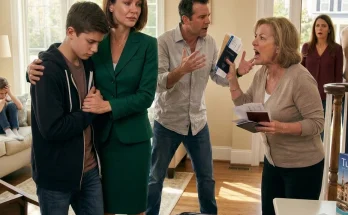
Patricia said, very quietly, “This is a family matter.”
“It is,” Thomas said pleasantly. “Which is why we thought it best to address it with all parties present.”
Daniel sat down on the porch step.
He looked at me finally.
Whatever he had expected from this afternoon, it had not been this. He had believed the geography was in his favor: the sold house, the packed boxes, the documents prepared, the grief he had timed. He had believed I would arrive home depleted and that the momentum of what they had built would carry me into signing before I understood what I was signing.
He had not known about the seven million dollars.
He had not known about the trust.
He had not known that Eleanor Whitmore had spent the last three years making absolutely certain that I would not be left without a floor to stand on.
“Claire,” Daniel said.
I waited.
“I can explain.”
“I know you can,” I said. “But I’m not going to listen to it today.”
Thomas Elias handed me the envelope from Eleanor.
The letter inside was handwritten on the stationery she had used my whole life, cream paper with her initials in the upper corner. Her handwriting in the last year had been slower, more deliberate, each letter placed with the care of someone who understood that effort was being spent and wanted to spend it well.
Claire, it began.
If you are reading this on the porch, then it happened as I expected it might. Don’t let them see you cry. You can do that later, privately, where it belongs. Right now, I need you to stand up straight and know the following things.
The house cannot be taken from you. Raymond has the documents.
The inheritance is yours without conditions and without anyone else’s name on it. Seven million dollars is enough to begin a new life from. I designed it that way on purpose.
You were never the problem in that marriage. You were simply the person who believed in it longer than it deserved. That is a quality, not a flaw. It is also over now.
Everything else is paperwork.
I love you beyond what the law can document.
Your grandmother, Eleanor.
I folded the letter and put it in my pocket.
“I’d like you both to leave this property,” I said.
Patricia made a sound.
“You cannot simply–”
“Thomas,” I said, “would you like to explain the current legal standing?”
Thomas turned to Patricia with the calm patience of someone who has done this many times.
“The property remains in Mrs. Whitmore’s name under the protective trust,” he said. “The sale agreement executed by Mr. Hartford is unenforceable. Anyone who is not Mrs. Whitmore attempting to access this property without her written consent would be acting without legal authority.”
They left. Neither said anything else. Daniel did not look back at the house.
I sat on the front step for a long time after they were gone.
The afternoon was mild. The street had its ordinary Saturday quality, a neighbor two houses down raking leaves, a car passing slowly, the small sounds of a neighborhood going about its business with complete indifference to what had just happened on this particular porch. The trees were in the specific phase of October turning where the gold is at its maximum and you understand, looking at it, that this is the peak and it will begin to diminish from here.
Eleanor had loved October. She always said it was the most honest month because it did not pretend to be anything other than an ending.
I thought about her in that moment. I thought about all the years she had watched my life from the patient distance she maintained, asking her careful questions and listening to the things I said around my answers, making her phone calls to Raymond and building her documents and setting her conditions and never telling me any of it because she knew I would have tried to object, tried to protect people who were not worth protecting at the expense of protecting myself. She had known me very well.
I cried, sitting on that step. Not the crying I had been holding back since the parking garage after the will reading. Different crying. The specific release of someone who has understood, finally and completely, that they were loved accurately.
The divorce was not quick, but it was clean in the way that things become clean when one party has good legal preparation and the other has been caught in the act of what they were doing. Daniel retained an attorney who spent two months trying to find grounds to contest the trust and found none, because Eleanor’s paperwork was impeccable in ways that left no useful ambiguity. Patricia made calls to relatives to build an alternative narrative. None of them found the purchase persuasive, and some of them, according to Raymond, had expressed a view that the situation reflected poorly on Daniel and his mother rather than on me.