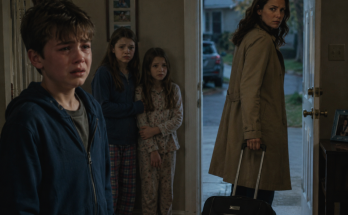
Not a single glance at his daughter. Not one word about the bruises covering her small body.
Roxanne pointed at me, her voice breaking into a rehearsed sob. “She came in like a maniac, Grant! Screaming at me! She tried to attack me! I’m so scared for the baby!”
Grant’s face darkened. He looked at me with contempt, the same contempt he’d shown when I first took this federal assignment. “Penelope, you need to calm down. Matilda is fine. She’s a tough kid. Roxanne is pregnant, her emotions are fragile. You can’t just barge in here and terrorize her. Apologize right now, change out of that filthy uniform, and we’ll discuss this rationally.”
Rationally. As if my child’s battered body was a topic for negotiation.
I stood up, Matilda still in my arms, her weight feather-light, her trembling vibrating through my own bones. I walked over to Grant, each step echoing on the hardwood.
“You promised me,” I whispered. “When she was born, you cried. You held her so gently I thought your world had changed. And you swore, on your own life, that no shadow would ever touch her.”
Grant’s jaw tightened. “Things change. Matilda is difficult. She’s stubborn, she doesn’t listen. Roxanne is doing her best. You were never here, Penelope. You don’t get to judge.”
I looked down at my daughter. She had buried her face in my neck, her tiny fingers clutching my collar. I could feel her heart pounding like a trapped bird.
I reached back and SLAPPED Grant across the face with every ounce of strength I had. The sound was a crack, sharp and crisp. He staggered, his cheek already reddening, shock replacing his arrogance.
“Starting today, Grant,” I said, my voice steady now, “you and that woman are going to learn exactly what it means to hurt the daughter of a mother who crawled back from hell.”
Roxanne shrieked something, but I didn’t hear. I walked out of that house, Matilda tight against my chest. Rain poured down, soaking us, washing the dust from my uniform. Grant stood in the doorway, screaming that if I left, I should never come back. That he’d get custody. That I’d regret this.
I didn’t look back. I loaded Matilda into the car, buckled her in with trembling hands, and kissed her forehead. She still couldn’t speak, but her eyes held a flicker of the girl she’d been.
I drove to the nearest safe house I knew, a cabin owned by a retired agent in the woods west of Bangor. The whole way, I talked to her. I told her about the stars I’d seen, the wolves I’d heard howl, the promise I’d made to bring her a stone from every place I’d been. Slowly, so slowly, her breathing evened.
When we got to the cabin, I bathed her in warm water. I catalogued every bruise, every scrape, documenting it all with photographs on my phone. I called my old commanding officer, someone who still owed me a favor from a firefight in Texas. I called a lawyer, a fierce woman who’d never lost a case. I called a social worker I trusted.
And then I sat by the fireplace, Matilda asleep in my lap, and I let the tears come.
Not tears of weakness. Tears of absolute, burning resolve.
I had survived cartel ambushes, desert storms, and internal betrayal among my own ranks. I had crawled through poison ivy for three miles to deliver intelligence. I had held the hand of a dying colleague and promised I’d finish the mission.
But this was different. This wasn’t about borders or national security. This was about flesh and blood. This was about a little girl who believed in me.
In the following days, I discovered the depth of the horror. Roxanne had moved into my home three weeks after I deployed. Grant had introduced her as Matilda’s “new mom.” She’d confiscated Matilda’s toys, locked her in her room for hours, and screamed at her whenever she made noise. The physical abuse had started a week ago when Matilda accidentally spilled juice on Roxanne’s dress.
I found out from a neighbor who’d been too scared to call the police—Grant had threatened to ruin anyone who interfered. The school had noticed bruises, but Grant had forged an excuse: “she fell at the playground.”