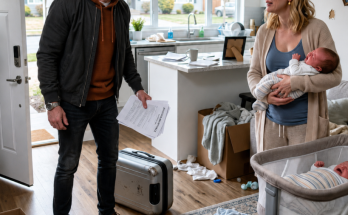
Rachel let out a shaky breath beside me.
The search produced what the police described as disturbing evidence: documentation targeting vulnerable children, recorded notes, and images that confirmed patterns the school had dismissed for years. It wasn’t just my daughter. It had never been just my daughter.
Jason Harrison was arrested on a Wednesday morning, three weeks after Lily lifted her sweater in the car.
The charges expanded quickly. Multiple counts of assault and child abuse. Possession of exploitative material. Abuse of authority.
As the investigation unfolded, more victims came forward. Some were teenagers now. Some families had moved away years ago, carrying shame they’d never named. The final number reached seventeen.
I didn’t tell Lily the number. She didn’t need that weight.
We shifted our focus to what she did need: safety, consistency, therapy.
Dr. Michelle Thompson, a child trauma specialist, began meeting with Lily weekly. The first months were brutal. Lily had nightmares. She startled at loud male voices. She froze when a teacher closed a classroom door.
Rachel and I learned the language of trauma in real time: triggers, grounding, safe routines. We learned to celebrate tiny victories, like Lily sleeping through a night or laughing without looking over her shoulder.
Six months later, the trial began.
Rachel and I attended every day. Lily was not required to testify in person. Her statement was recorded and used appropriately. The defense tried everything—attacking credibility, questioning memory, suggesting hysteria, throwing mud at parents.
But truth is heavy. Seventeen kids is heavier.
Mrs. Patterson testified about patterns she’d observed. Dr. Chen testified about injuries consistent with repeated harm. Electronic evidence filled in the spaces where systems had demanded “corroboration” before believing children.
Jason Harrison was convicted on sixteen of nineteen counts.
The judge sentenced him to twenty-three years.
The superintendent resigned under pressure. The board chair stepped down. Administrators who had dismissed prior complaints were reassigned. New mandatory reporting training was implemented. Independent oversight procedures were introduced. Transparency policies were written in ink, not promises.
But the real ending wasn’t in a sentence from a judge.
It was in Lily, slowly returning to herself.
Part 4
The first time Lily laughed again—really laughed, belly-deep and surprised—it happened over something stupid.
Rachel was trying to make pancakes into “pumpkin shapes,” and the batter kept turning into lopsided blobs. Lily watched from her stool at the kitchen counter, face serious like she was evaluating a scientific experiment. Then one pancake slid off the spatula and landed in the pan folded like a sad taco.
Lily stared at it.
Rachel stared at it.
And then Lily giggled. It was small at first, like a cautious door opening. Then it grew until she was laughing hard enough she had to wipe her eyes.
Rachel’s face crumpled. She turned away fast, pretending she needed to check the heat, but I saw the relief hit her like a wave.
That’s what healing looked like at first: tiny, fragile moments that felt like oxygen after drowning.
Even after Harrison’s arrest, the world didn’t magically become safe. Lily’s fear had grooves now. Some mornings she woke up bright and almost normal. Other mornings she curled into herself and whispered, “Is he coming back?”
“No,” I would say, every time, until the word was something she could hold. “He can’t. He won’t. You’re safe.”
We moved Lily to a different school mid-year. Not because Maplewood didn’t have good teachers, but because Maplewood was full of ghosts. The hallway smell, the office door, the principal’s voice on announcements—all of it was a minefield.
Her new school was smaller, with a principal who introduced herself to us with direct eyes and a promise that felt like a contract.
“If Lily says something feels wrong,” the principal said, “we listen. No exceptions.”
Rachel and I started attending school board meetings regularly. Not for drama. For accountability. We weren’t the only family doing it now. A parent coalition formed quickly—families from Maplewood, teachers who were tired of being told to stay quiet, community members who realized reputation had been used as camouflage.
We pushed for specific changes:
truly independent investigation procedures
mandatory reporting training with real oversight
periodic audits of staff-student contact protocols
clear reporting channels for students and parents
a policy that administrative leave is automatic when credible allegations are raised, regardless of title
Some board members rolled their eyes at first. Some administrators bristled.
Then parents started showing up in numbers large enough to fill the chamber without needing a “big incident” to motivate them. Quiet, consistent pressure. The kind institutions can’t wait out forever.
Mrs. Patterson became an unlikely leader.
I used to think she was fragile, the way she cried when she admitted she’d stayed silent too long. But what I learned is that guilt can turn into fuel when someone finally decides they won’t carry it alone.
She began training other teachers in recognizing warning signs and documenting concerns properly. She spoke openly about the fear of retaliation and how systems weaponize that fear.
“I thought staying quiet was protecting my job,” she said at one meeting, voice steady. “It turned out it was protecting a predator.”
The room went silent, and then people started clapping—not because applause fixed anything, but because truth deserves witnesses.
In therapy, Lily learned to name what happened without drowning in it. Dr. Thompson used simple phrases Lily could grasp.
“What happened to you was not your fault.”
“Your body belongs to you.”
“Adults are responsible for keeping kids safe.”
Lily drew a lot at first. Not of Harrison. Not of school. She drew animals—foxes, rabbits, owls—creatures with big eyes and hidden dens. Dr. Thompson explained that kids often process safety through metaphor before they can talk directly.
One day, Lily drew a small bunny standing in front of a giant gate with a tiny sign that said, Stop.
Dr. Thompson smiled gently. “That’s a boundary,” she told Lily.
Lily looked up. “A boundary is like a rule for your body,” she said, like she was practicing.
“That’s right,” Dr. Thompson said. “And you’re allowed to have them.”
Rachel cried in the car afterward.
“I hate that she had to learn this way,” Rachel whispered.
“I know,” I said, gripping the steering wheel. “But she’s learning it. And we’re making sure she never has to learn it alone again.”
The trial ended, but the ripple effects didn’t. News trucks camped outside the district office for a week. Parents argued online. Some people insisted the community was being “overly reactive.”
There were still adults who wanted the story to be about inconvenience instead of children.
But we refused.
Two years passed. Lily turned nine. She started fourth grade with a backpack covered in paint splatters because she’d discovered art club and became obsessed with acrylics. She made friends. She started roller skating. She complained about math homework like a normal kid.
She still saw Dr. Thompson occasionally. Not because she was broken, but because healing is maintenance, not a finish line.
One evening, Lily helped me chop vegetables for dinner. She was humming under her breath, hair pulled back, concentrating.
“Dad,” she said suddenly, without looking up, “you know what I learned?”
“What?” I asked.
She paused, knife hovering carefully like she’d seen Rachel do. “Speaking up is scary,” she said. “But staying quiet is scarier.”
My throat tightened.
“You’re absolutely right,” I said.
She nodded like she was stating a fact, not a hero speech.
“And also,” she added, “being brave doesn’t mean you’re not scared.”
I smiled, even as my eyes burned. “That’s exactly what it means.”
Later that month, I received a letter from another family. Their daughter had been one of the victims. The note was short, handwritten in careful kid letters:
Thank you for believing Lily. Because you fought for her, my parents believed me too.
I kept that letter in my desk drawer.
On hard days—when I thought about how close we came to being dismissed, how easily Lily could have stayed silent—I’d take it out and reread it.
Because the truth is, the system didn’t save our child.
Our child saved our child, by speaking.
We saved her, by believing.
And together, we forced a community to stop worshiping reputation and start protecting kids……
Part 5
The first time I ran into someone who still defended Jason Harrison, it wasn’t online. It was in line at a coffee shop.
I’d stopped in after dropping Lily at her new school. It was one of those mornings where the sky was low and gray and everyone looked like they wanted to crawl back into bed. I was half-awake, waiting for my drink, when a woman behind me said my name.
“Marcus Sutherland?”
I turned. She was a Maplewood parent I recognized vaguely—PTA committee, always dressed like she’d stepped out of a lifestyle blog.
“I just want to say,” she began, smiling too tightly, “it’s been such a shame what happened. For everyone.”
My stomach tightened. “For the kids,” I corrected gently.
Her smile flickered. “Of course,” she said quickly. “But you know, the whole community… the school’s reputation… it’s been really hard. And some people think—”
“Some people think what?” I asked, voice calm.
She lowered her voice as if she was sharing a secret. “That it got blown up,” she said. “That it turned into this… frenzy. People are afraid to even hug kids now. Teachers feel watched.”
My coffee order was called, but I didn’t move.
“Seventeen children,” I said quietly.
Her eyes darted away. “I know, I know, but—”
“No,” I said, still quiet. “No ‘but.’ Kids were harmed. Adults ignored warnings. The only thing that got ‘blown up’ was the illusion that reputation is safety.”
Her cheeks flushed. “I’m just saying it’s complicated.”
“It’s not,” I said. “It’s painful. It’s ugly. But it’s not complicated.”
I took my coffee and walked out, hands shaking—not from fear of her, but from the exhausting realization that some people would rather protect their comfort than protect children.
That conversation became a turning point for Rachel and me. We’d been advocating reactively—responding to the crisis, pushing policy, attending meetings. Now we realized we needed to shift toward something deeper: changing culture, not just paperwork.
So we started speaking publicly, carefully, and often.
Not on national TV. Not as sensational “victim parents.” We spoke at local district meetings across the province. We spoke at teacher training workshops. We spoke to parent groups. We told the story in a way that centered kids and systems, not our own rage.
Rachel was powerful in those rooms. She didn’t raise her voice. She didn’t need to. She spoke like a medical professional used to bureaucracy.
“Institutions like to treat reporting as a box to check,” she said at one meeting. “But reporting is not the goal. Safety is the goal. When reporting leads nowhere, families stop trusting the system. Then the system becomes the threat.”
I spoke in the language I understood: patterns and failures and predictable vulnerabilities.
“Predators don’t pick random environments,” I told a group of administrators. “They pick systems with weak oversight and strong reputational shields. They pick institutions that equate ‘well-liked’ with ‘safe.’ And they rely on adults being afraid to look paranoid.”
We helped the parent coalition create a formal structure: committees for policy review, communication, and peer support. We set up a confidential network for parents to share concerns without fear of being labeled dramatic. We created a resource list of child trauma therapists, legal contacts, and reporting steps.
We pushed for one policy change that mattered more than anything else: independent oversight that was triggered automatically. No superintendent deciding whether a complaint was “credible enough” to warrant action. No district investigating itself while the accused stayed in place.
We weren’t naive. Policies can be ignored. But policies can also become tools parents can point to, like a hand on the table saying, This is the rule. Follow it.
One year after Harrison’s sentencing, the district held a public forum about “restoring trust.” The phrase made Rachel roll her eyes.
But we went anyway.
The superintendent was new. The board chair was new. There was a glossy presentation about improved training and transparency. There were buzzwords about “community partnership.”
Then the microphone opened for questions.
A dad stood up and said, voice shaking, “How do we know this won’t happen again?”
The room went quiet. The superintendent began a careful answer about protocols and background checks, but it sounded too polished.
I stood up.
“You don’t know,” I said plainly. “Not with certainty. Because safety isn’t a guarantee. It’s a practice. You build it every day with oversight and humility and the willingness to believe children.”
People murmured.
“And you build it,” I continued, “by refusing to protect reputation more than kids. The moment you start worrying about ‘how it looks’ instead of ‘what is true,’ you’re building the same hiding place all over again.”
Afterward, a teacher approached me, eyes tired.
“Thank you,” she said. “A lot of us wanted to speak up before. But we were afraid.”
“I know,” I said. “And I’m not here to blame teachers who were trapped. I’m here to blame the traps.”
That winter, Lily asked to come with us to one coalition meeting.
Rachel hesitated. “It might be boring,” she said.
Lily shrugged. “I want to see,” she said.
We sat her in the back with crayons and paper. She drew while adults talked about policies, audit schedules, and training modules. Halfway through, Lily leaned toward me and whispered, “Dad, they’re listening now.”
I swallowed. “Yes,” I said. “They are.”
When the meeting ended, Lily handed Rachel her drawing.
It was a school building with windows. In every window, she’d drawn an eye.
Rachel blinked. “What is this?” she asked.
Lily looked up seriously. “It’s the school looking back,” she said. “So no one can hide.”
Rachel hugged her so tight Lily squeaked.
That night, after Lily went to bed, Rachel and I sat on the couch in the dark. The house was quiet. Normal quiet, not fear quiet.
“Do you ever think about that night in the parking lot?” Rachel asked softly.
“All the time,” I admitted.
Rachel’s voice shook. “What if she hadn’t told you?”
My chest tightened. “She did,” I said, firmly. “She did. And we believed her.”
Rachel nodded, tears slipping down her face. “I’m proud of her,” she whispered.
“So am I,” I said. “And I’m proud of us.”
Rachel exhaled and wiped her cheeks. “You know what the scary part is?” she said. “People think it’s over because he’s in prison.”
“It’s not over,” I said. “It’s just… contained.”
Rachel nodded.
Because that was the truth. Jason Harrison was in prison. But the cultural reflex that protected him—dismissing kids, protecting reputation, fearing discomfort—didn’t disappear with a sentence. It had to be rewired.
And we were going to keep doing that work.
For Lily.
For the other kids.
For the next child who would whisper, Dad, can we talk in the car?
Part 6
The year Lily turned ten, she joined the debate club at her new school.
It sounded funny at first—Lily, who used to hate raising her hand, suddenly volunteering to stand in front of a room and argue about whether homework should be banned. But Dr. Thompson called it a sign of recovery.
“Trauma steals voice,” she told us. “One way kids reclaim it is by practicing speaking in safe, structured environments.”
Lily didn’t frame it that way. She just said, “I like winning,” with a grin that made Rachel laugh through her worry.
On Lily’s first debate day, Rachel and I sat in the back of the classroom on tiny chairs, smiling like proud idiots. Lily stood at the front with her teammates, holding note cards. Her voice shook at first, then steadied.
She spoke clearly. She made eye contact. She didn’t shrink.
I felt my throat tighten with something that wasn’t sadness, exactly. It was awe. Because when your child survives something that should have crushed them, you stop taking their ordinary courage for granted.
After the debate, Lily bounced over to us.
“Did I talk too fast?” she asked.
“No,” I said, and my voice went thick. “You were amazing.”
Rachel hugged her. “You were brave.”
Lily rolled her eyes. “I was nervous,” she corrected. “But I did it anyway.”
Rachel and I shared a look. Lily had built her own definition of bravery, and she lived by it.
That spring, the parent coalition achieved something we hadn’t dared to expect: the province announced a new framework for school-based abuse investigations. It required independent investigators for allegations involving administrators and mandated temporary removal from duties pending review.
It wasn’t perfect. It wouldn’t catch everything. But it closed one of the exact gaps Harrison had used: the ability of districts to investigate themselves while keeping the accused in power.
A reporter called us for a quote.
Rachel declined. “This isn’t about us,” she said. “This is about kids.”
But the reporter persisted, so we agreed to a short statement, factual and calm.
“We’re grateful the province has taken steps to strengthen oversight,” we said. “Our hope is that no child’s safety will ever be weighed against an adult’s reputation again.”
The day the announcement went public, Lily came home with a drawing.
It showed a scale, like Lady Justice holds. On one side she’d drawn a kid. On the other side she’d drawn a trophy labeled reputation. The kid side was heavier.
At the bottom, Lily had written: Kids matter more.
Rachel taped it to the fridge.
For a while, life felt almost normal again. Lily had sleepovers. She learned to ride her bike without training wheels. She complained about math. Rachel and I argued about whether we needed a bigger couch. Ordinary problems, the kind that feel like blessings when you’ve lived through something extraordinary.
Then, one Tuesday afternoon, I got an email that made my stomach drop.
Subject line: Maplewood Class Action Interest
A law firm was exploring a class action against the district on behalf of families affected by Harrison’s abuse and the district’s negligence. They wanted to know if we would participate.
Rachel and I sat at the kitchen table reading the email twice.
“I don’t want this to become Lily’s whole life,” Rachel said quietly.
“I don’t either,” I said. “But accountability matters.”
We consulted Maya Singh again. She explained the pros and cons: financial compensation, public record, forcing systemic change through legal pressure, versus prolonged exposure, stress, and the risk of sensationalization.
The deciding factor came from Lily herself, without her knowing it.
One night she asked, “Do you think the school knew?”
Rachel’s face tightened. “Some adults suspected,” she said carefully. “Some adults ignored signs.”
Lily stared at her cereal bowl. “Why?”
Rachel reached across the table. “Because sometimes adults protect their comfort,” she said gently. “And they tell themselves it’s not that bad.”
Lily looked up, eyes serious. “That’s not okay,” she said.
“No,” I said. “It’s not.”
Rachel and I decided to join, but with one condition: Lily’s privacy would be protected as much as possible. We would not do media interviews. We would not allow her name to become a headline.
The legal process was slow. Depositions. Documents. Emails uncovered. The kind of behind-the-scenes reality that showed how institutions protect themselves: administrators discussing “risk management,” staff being warned not to “speculate,” concerns being labeled “misinterpretations.”
Some of it was sickening.
One email from years earlier showed a district official advising that a complaint should be “handled quietly to avoid public concern.”
Rachel read it and said, voice shaking, “Public concern. That’s what they called kids being hurt.”
It fueled us through the months of legal grind.
During that time, Mrs. Patterson reached out.
She’d retired, but she didn’t disappear. She continued training teachers in recognizing abuse indicators and documenting concerns in ways that couldn’t be easily dismissed.
“I wish I’d been braver sooner,” she told Rachel one afternoon over tea.
Rachel squeezed her hand. “You’re brave now,” she said. “And that matters.”