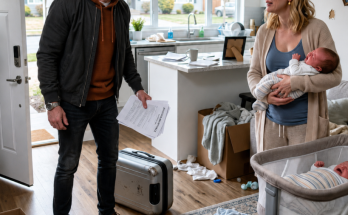
Olivia stepped forward. Her small voice pierced the morning air. ‘Grandma, can I come?’
Before I could answer, Celeste yanked her back. ‘Absolutely not! You see what she’s doing? She’s abandoning us!’
But I saw Olivia’s eyes. They weren’t begging. They were asking for permission to believe in a world where grandmothers could be free.
I knelt down, ignoring the cracking in my knees. ‘Sweetheart, I’m not abandoning you. I’m going to find a part of myself I lost before you were born. And when I come back, I’ll be more whole. That’s better for both of us, I promise. You have my letter?’ I had mailed her a short note the day before, explaining in simple words that sometimes adults need to fix their own hearts before they can be good for anyone else.
She nodded, her lip trembling. Benjamin just stood there, deflated, the weight of thirty years of unearned comfort crashing down around him.
I stood, hugged Olivia tight, and then got into the taxi that had pulled up. I didn’t look back as we drove away, though I heard Celeste’s shriek of rage and Benjamin’s desperate calling of my name. I kept my eyes on the horizon, where the plane was waiting.
The Amalfi Coast was everything Harold had promised in his whispered bedtime stories of future adventures. The sunsets bled orange and pink into a sea so blue it hurt. I ate lemon granita and walked the narrow streets until my feet ached. I bought a silk scarf from a street vendor and learned five Italian phrases. I felt, for the first time since widowhood, that my body was my own, my time was my own, my money—what was left of it—was my own.
Two weeks into my trip, I finally checked my phone. Among the hundreds of frantic messages, one stood out. It was from Mrs. Patterson, dated three days after my departure. It read: ‘Eleanor, your son and daughter-in-law came by the bank. They’re furious, of course, but that’s not important. What’s important is that Olivia slipped me a note under the desk when they weren’t looking. She said to give it to you when you’re ready. I have it safe. When you come home, it will be here. P.S. I saw your flight receipt—I hope you’re smiling.’
A note. From Olivia. A child who, at twelve, understood more than her parents ever would. The mystery of it gripped me. I didn’t call. I didn’t write back. I tucked the message away like a future anchor point, a thread connecting my new life to the old one.
I stayed in Italy for three months, not because I was hiding, but because I was healing. I volunteered at a local library, shelving books I couldn’t read, and found a community of expatriates who understood the quiet sorrow of starting over. I taught them to make chocolate mousse, the recipe now stained with olive oil instead of tears.
When autumn turned to winter, I knew it was time. I flew home on a cold December morning, the plane descending through clouds over a city that looked smaller than I remembered. Mrs. Patterson met me at the airport, holding a manila envelope and a surprising warmth in her greeting. She drove me to my house, which had been cleaned and aired by a neighbor, untouched by the drama I left behind.
In the kitchen, with tea brewing, I opened the envelope. Out fell a single sheet of paper, folded into a tiny square, covered in Olivia’s careful, looping handwriting. It read:
‘Dear Grandma,
I know why you left. I heard Mom say you were paying for everything and I heard Dad say you ruined the dinner because you didn’t come even though you weren’t invited and that made no sense. I think they are mean to you. But I am not mean. I love you more than the piano and more than all the horses.
I saved all my birthday money and it’s in my shoe box. It’s $342. I know it’s not a lot but I want to give it to you so you can go wherever you need to go. Because you paid for my life and I think you should have a life too.
Please don’t be sad.
Love,
Olivia
P.S. If you ever come back, can you teach me to make the mousse? Mom says you never make it right but I think she’s lying.’
The tears came then, not the bitter ones of betrayal, but the cleansing ones of absolute, uncomplicated love from the one person in that family who saw me.
I never gave Benjamin another cent. The house went into foreclosure, and they moved to a smaller place. Celeste’s brother had to get a real job. The fallout was immense, and I was blamed for all of it. But I also started weekly video calls with Olivia, teaching her the mousse recipe, and eventually, when she turned sixteen, she came to live with me for a summer. That summer changed her life, and it changed mine more profoundly than any trip to Italy.
But that’s another story. The one that matters is this: at 74, I learned that you can be a mother, a grandmother, and a person—all at once. The trick is to never let anyone convince you that your existence is contingent on your usefulness. And if you ever burn the collar of your best dress because you’re crying while ironing, stop. Put down the iron. Open your husband’s old letter. And buy yourself the ticket. The Amalfi Coast will wait. But so will your own heart, and it’s been waiting long enough.