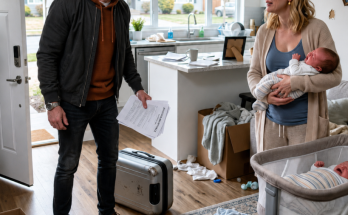
“Please,” he said. “They are not safe here.”
That word did what command could not.
Mara turned to the children. “Shoes. Coats. Turtle game.”
Finn sniffed. “The fast one?”
“The fast one,” she said. “Heads down, hands together.”
Wesley understood then that she had prepared them for this possibility. Not with fear, but with games. She had raised them inside a world where his name was a risk even before they understood it.
His shame had no bottom.
They left through the back. Wesley offered to take them to one of his secured properties, but Mara refused.
“I am not putting my children inside another Hart cage.”
So he let her choose.
She chose her attorney’s farmhouse outside Bellingham.
The Truth Under The Floorboards

June Harlow opened the farmhouse door in a cardigan, holding a flashlight like she planned to argue the darkness into submission.
“You brought him?” she asked Mara.
“He brought the trouble,” Mara said.
“Naturally.”
Inside, the twins drank cocoa at the kitchen table while adults spoke in low voices. Wesley stayed near the doorway, unsure where he had permission to stand.
Eliza looked at him suddenly.
“Are you really named Wesley?”
“Yes.”
“You look sad.”
Mara froze.
Wesley looked at his daughter for the first time without trying to hide.
“I am,” he said.
Finn narrowed his eyes. “Did you make Mom sad?”
The kitchen became very still.
Wesley answered softly, “Yes.”
Finn seemed to consider that. “Don’t do it again.”
Wesley lowered his head. “I’ll try very hard not to.”
Later, after the children slept, June brought out old records she had gathered over the years: clinic notes, hospital filings, strange payments, sealed amendments to the Hart trust.
Then came the knock.
A former nurse named Iris Dale stood on the porch, gray-haired and frightened, with Celeste behind her.
Celeste looked nothing like the flawless woman from fundraisers. Her coat was buttoned wrong. Rain clung to her hair. Her face was pale, bare, human.
Mara’s voice turned flat. “Why is she here?”
Celeste opened her handbag and placed a flash drive on the table.
“Because I helped ruin your life,” she said, “and I am done being useful to cruel people.”
The truth came out in pieces.
Celeste’s older sister, Camille, had worked in records at the clinic. Leonard had used her to alter files, to feed Wesley lies, to make Mara look dishonest. When Camille later learned Mara was expecting twins, the scheme became dangerous in a new way. The children meant the Hart trust would activate. Leonard had needed them hidden, discredited, or legally questioned.
Iris, who had worked at the hospital when the twins were born, had stopped Camille from entering the nursery area under false clearance. Afterward, Iris was paid to leave town and warned never to speak.
Celeste confessed what she had known and what she had chosen not to know.
“I wanted the life,” she told Mara, her voice shaking. “I wanted Wesley. I told myself powerful families always played ugly games. But I never wanted your children touched by any of it.”
Mara did not forgive her.
Not that night.
But she listened.
Then Celeste revealed the last piece.
Camille had not vanished after an old car incident, as everyone believed. She was alive, hidden, and ready to testify. She had kept copies of everything because even guilty people sometimes fear the people they serve.
Wesley looked at Mara across the farmhouse table.
For years, he had believed a lie because it was easier than trusting the woman who loved him.
Now the truth had arrived, and it did not cleanse him.
It only showed him where the damage began.
Six Months Later

By spring, the Hart name was no longer whispered only in private dining rooms.
It appeared in courtrooms, records, and headlines. Wesley testified. So did Celeste. So did Camille, from a protected location. Leonard Hart’s network of hidden accounts, altered medical documents, and private pressure finally came into the open.
People called Wesley brave.
Mara called it overdue.
That was fair.
He did not ask for more than she was willing to give.
At first, he saw the children twice a week at June’s farmhouse, always with Mara there, always after asking. He came as Wesley, not Dad. He learned Finn hated olives but called them “green buttons.” He learned Eliza loved astronomy and asked questions that made adults nervous. He learned both children slept better with the hallway light on.
He learned how much of their lives had already happened without him.
One afternoon, after a supervised visit at a park near the water, Finn ran ahead to look at ducks while Eliza collected smooth stones. Mara stood beside Wesley beneath a maple tree just beginning to leaf out.
He took a small envelope from his coat pocket and handed it to her.
Inside was her old wedding ring.
Mara stared at it.
“Why are you giving me this?”
“Because I kept it like it belonged to me,” he said. “It doesn’t. Neither do you. Neither do they.”
She looked at him for a long time.
“You understand that love doesn’t erase what happened?”
“Yes.”
“And regret doesn’t make you safe?”
“Yes.”
“And if they ever call you Dad, it will be because they choose it, not because you earned the title in court?”
His throat tightened.
“I know.”
Mara closed the envelope.
She did not put the ring on.
She slipped it into her pocket, not as a promise, but as proof that something real had once existed before fear, pride, and other people’s greed broke it apart.
Across the grass, Finn shouted, “Wesley! The ducks are fighting over bread again!”
Eliza corrected him immediately. “They’re negotiating.”
For the first time in years, Mara laughed without guarding it.
Wesley looked at her, then at the children, and understood that this was not a happy ending in the simple way people liked to imagine.
It was slower than that.
Harder.
More honest.
It was a man learning to wait outside a door he once slammed shut. It was a mother deciding, day by day, whether a careful step was worth taking. It was two children carrying a name that would no longer be used as a chain.
And on that bright Seattle afternoon, with the water shining beyond the trees and his family standing just out of reach, Wesley Hart finally understood that forgiveness was not something he could demand.
It was something he would have to become worthy of, one quiet day at a time.