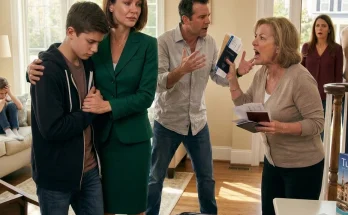
And on this day, I would later learn, they had decided my son would be the price.
In the hospital room, the scene was frozen in a tableau of horror. A guard stood by the door, blocking the only exit. The nurse was on the phone, her voice a low, urgent murmur as she called for the doctor on duty. Galina played her part with chilling precision, her voice breaking as she spoke of my “psychosis,” a single, perfect tear tracing a path down her cheek.
Postpartum. It’s a word that carries so much weight. For strangers, it’s a convenient label for a woman in crisis. My hair was a tangled mess. My face was pale and slick with sweat. My hands were trembling from adrenaline and pain. I was screaming my son’s name. It was terrifyingly easy to paint me as a dangerous woman.
I found my voice, ragged and raw. “She hit me. She tried to take my son.”
Galina cut me off, her performance flawless. “Look at her! She’s delirious. She’s been like this for weeks, we’ve been so worried.”
And then, something shifted. The head of security, a man with tired but intelligent eyes, looked at me. Really looked. Not as a hysterical patient, but as if trying to place a familiar face. A flicker of recognition, almost imperceptible. I wouldn’t have caught it if I hadn’t spent my entire professional life reading the subtle language of the human face.
“Your Honor?” he asked, his voice low, a question aimed only at me.
The room fell so silent I could hear the faint hiss of the oxygen tank behind the wall.
Galina Petrovna blinked, her practiced tears drying on her cheeks. She hadn’t processed it yet. “Pardon?” she asked, her tone sharp with irritation.
The security chief straightened his shoulders, his posture shifting from hospital guard to something more formal, more deferential.
“Judge Elena Vorontsova. Federal District Court.”
He said it without any particular emphasis, but the quiet simplicity of the statement shattered the reality Galina had so carefully constructed. The color drained from her face so fast it was as if someone had pulled a plug. Her bones seemed to dissolve beneath her skin, leaving her sagging inside her expensive coat.
Leo, sensing the shift in tension, began to wail again, a full-throated, healthy scream of protest. One of the other guards moved cautiously toward my mother-in-law.
“Ma’am, please hand the child to the nurse.”
She didn’t move. Her arms were locked around my son. For the first time since I had known her, I saw real, primal fear in her eyes. Not for her grandson. For herself.
“There’s… there’s a mistake,” she stammered, her lips suddenly dry and pale. “She… she doesn’t do anything. She stays at home. Artyom supports her.”
A laugh, sharp and bitter, tried to escape my throat, but the pain turned it into a choked gasp. How many months had she spent telling her friends that her son was burdened with a lazy, ambitionless wife? How many times had she commented in my presence that my hands were soft because they’d never known a day of real work? She had looked at my books, my posture, my very way of being, as a suspicious affectation. She never once tried to learn the truth, because the humiliating version she’d invented was so much more convenient. It affirmed her power.
“The patient has a fresh bruise on her cheek,” the nurse said, her voice now crisp and authoritative. “And a recent surgical incision. Remove the child from her custody. Now.”
This time, it was an order. Galina had no choice but to relinquish Leo. As the nurse gently placed my warm, crying son into the bassinet beside my bed, I finally broke. The tears came in a hot, ugly flood, the kind you cry not for what is happening, but for the postponed horror of what could have happened. If that security chief hadn’t been on duty. If he hadn’t presided over a minor traffic case in my courtroom two years ago. If, if, if.
Minutes later, the room was a hive of controlled activity. The head of the maternity ward arrived, followed by an investigator from the local police precinct. The hospital administration was officially notified. A request was immediately put in for security footage from the hallway cameras.
The nurse gave her statement. Then the aide. It turned out Galina had not come alone. Veronica had been with her, waiting in a running car by the emergency room entrance.
In the back seat was an empty infant car seat.
Hearing that detail, a new wave of cold, colder than any surgical theater, washed through me. This wasn’t an impulse. It wasn’t a moment of family drama or misguided hysteria. They had planned this. They had come prepared to steal my child. The documents they’d tried to serve me, which I’d slapped away, were fake, but expertly crafted. They were filled with the letterhead of a private notary and legalistic language designed to terrify a woman weakened by surgery, isolated and alone. They had targeted my most vulnerable moment.
They asked me if I wanted to call my husband. I closed my eyes. That phone call scared me almost as much as what had just transpired. Because what happened next didn’t depend on my title, or the cameras, or the police. It would depend entirely on who Artyom chose to be when there was no more room for excuses, no more peace to be kept.
Artyom arrived in forty minutes that felt like forty years. I watched the door handle, the shadow moving behind the frosted glass, the wet tracks of boots in the hallway. When he entered, his face was a mask of worried confusion, the look of a man still desperately hoping this was all a terrible misunderstanding.
Then he saw the purple bruise blooming on my cheek. He saw Leo, safe in the bassinet next to me. He saw the uniformed police officer standing by the window.
And in that moment, he aged a decade.
“Lena…” he started, taking a step toward me.
I flinched. Just a tiny, involuntary recoil. But it was enough. The invisible chasm that had been slowly widening between us for years was suddenly a vast, uncrossable canyon. He stopped, his hand still outstretched. He understood.
“Your mother tried to take our son,” I said, my voice flat, devoid of the emotion churning inside me. “Your sister was waiting in the car with a car seat.”
He was silent for a long, heavy moment. This was it. The moment a person decides who they are going to be for the rest of their life. A son. A husband. A father. Or a coward, choosing the path of least resistance, the role that causes him the least immediate pain.
“Mom said… she said you weren’t yourself after the operation,” he finally managed to say. He wasn’t saying it because he believed it. He was saying it because he needed one last, flimsy bridge to his old life, one last chance to pretend this wasn’t as monstrous as it was.
I looked at him then, truly looked at him, in a way I never had before. Not with pleading. Not with the hope of being loved and protected. But with the cold, clear assessment of a judge weighing evidence.
“The cameras recorded everything, Artyom.”
He sank into the cheap plastic visitor’s chair against the wall, his body folding in on itself. That chair, always an afterthought, curved and uncomfortable. An extra. For the first time in his life, he couldn’t be saved by placating words or a well-timed compromise.
Through the window in the hallway, I could see Galina. She wasn’t performing anymore. She was sitting on a hard bench under a flickering fluorescent light, her fur coat pooled on the seat beside her, its power faded along with its owner. Later, they brought Veronica in. She was sobbing, talking about her despair, her treatments, how she just wanted to be a mother too. On any other day, my heart might have felt a pang of sympathy. But not today. Not on the day my son smelled of another woman’s cloying perfume instead of milk and antiseptic. Not on the day my cheek burned from a blow meant to silence me. Not on the day my child had been carried toward the door in the arms of a thief.
The investigator asked me questions. I answered them calmly, professionally. It’s a strange reflex of my profession. When everything inside you is collapsing, your voice becomes even and steady. It’s not strength. It’s a survival mechanism. When they asked me to sign the protocol, my hand trembled so violently the pen scratched against the paper.
The head of security had remained nearby, a silent, reassuring presence. He asked no unnecessary questions. He offered no false comfort. He simply stood witness, and for that, I was profoundly grateful. Sometimes, a person’s decency is shown not in what they do, but in what they don’t do. He saw more than he said.
Artyom waited until everyone else had filed out. The room was quiet again, filled only with the soft snores of Leo and the swish of snow against the windowpane.
“Why didn’t you ever tell them?” he asked, his voice hollow. “Who you were.”