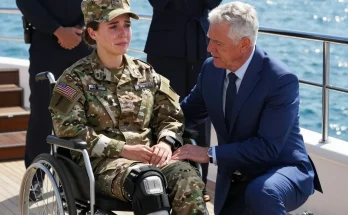
I sat on the porch steps, the phone dangling from my fingers, and watched the sun sink behind the pines. The lake turned orange and pink. I thought about calling her back and giving in. It would be easier. It would silence the noise. But then I remembered the last week of Margaret’s life. Barbara had come to the hospital for exactly forty-five minutes. She spent thirty of those minutes on her phone, complaining about a catering issue for her book club. Margaret had turned to me after she left and whispered, “Henry, promise me something. When I’m gone, stop letting her take your soul. You have so much love to give. Give it where it’s really needed.”
That night, I didn’t sleep. I paced the cabin, the moon bright enough to cast shadows of the window frames across the floor. And then, around 3 a.m., the idea arrived—not like a whisper, but like a steady, warm light.
Sunshine Horizons Camp. Margaret had volunteered there one summer years ago. They provided outdoor retreats for children with physical disabilities—kids who rarely got to experience swimming, campfires, fishing. Their program was always struggling for space. I called them at 9 a.m. sharp.
A young director named Rachel answered. I explained that I had a accessible cabin on a lake, with trails and a dock, and that I wanted to host a week-long retreat in memory of my wife. Rachel started crying. “We’ve been praying for a location like this,” she said. “Could we do the week of July 15th?” That was the exact week Barbara had demanded. I smiled. “July 15th is perfect. And I have one condition: the cabin is exclusively yours that week. No other guests.” We signed a contract within days. I paid for extra insurance out of my own pocket and sent a donation for supplies.
Then I called Barbara back. I kept my voice light. “You were right, sis. I’ve been selfish. Please, come with all twenty-two of Greg’s family. July 15th. I’ll take care of everything—just show up.” Her shriek of delight nearly burst my eardrum. “Oh, Henry! I knew you’d listen to reason. This is going to be the best vacation ever!” She hung up, and I heard her already calling someone to gloat.
The next six weeks were a blur of purpose. I woke every day with a mission. I built a wheelchair ramp out of pressure-treated wood, my old hands aching but my spirit soaring. I painted the guest room a soft blue because Rachel said certain colors calmed kids with sensory issues. I contacted local grocery stores, and they donated marshmallows, juice boxes, and gluten-free snacks. A hardware store owner, after hearing my story, gave me a discount on life jackets. I felt Margaret’s presence in every nail I hammered, every shelf I cleared.
The week before July 15th, I couldn’t sleep from excitement. I drove into town and picked up a giant banner from a print shop: “Margaret’s Haven Retreat – Love in Action.” I hung it between two pines at the entrance. I set up a fire pit with log seats. I placed Margaret’s favorite rocking chair on the porch, overlooking the lake, with a small plaque that read, “Sit here and know you are loved.”
July 15th arrived in a blaze of sunshine. The camp vans rolled in at 10 a.m. The first child out was a little girl named Lily, ten years old, with bright red hair and leg braces. She looked at the cabin, the lake, the banner, and gasped. “Is this what heaven looks like?” I bent down, my knees creaking, and said, “It’s what love looks like, Lily.” She threw her arms around me without hesitation. A boy named Marcus, who used a motorized wheelchair, zoomed straight for the dock, yelling, “I’m gonna see a fish! I’m gonna see a real fish!” A teenage volunteer with Down syndrome, Sarah, started leading a chant about s’mores.
I was in the middle of showing Marcus a bluegill fish when I heard the engines. A distant rumbling, then closer. A cloud of dust billowed up from the gravel road. Three SUVs. A silver Cadillac in the lead. Barbara.
They crested the hill and stopped abruptly. Doors flew open. Barbara stepped out first, wearing a crisp white linen pantsuit and a wide-brimmed straw hat, looking like she was about to walk onto a yacht. Her expression shifted rapidly: a triumphant smile for the first three seconds, then confusion, then a dawning horror as she saw the children, the counselors, the banner, and me, kneeling by a wheelchair, wearing a camp-branded t-shirt and a baseball cap.
“Henry?!” Her voice cut through the happy chatter.
I stood up slowly, my knees protesting, but my heart steady. I walked over, the gravel crunching under my sneakers. “Welcome, Barbara. And hello, everyone,” I said, nodding at Greg’s relatives who were now spilling out of the cars, looking bewildered. Greg’s mother, a soft-faced woman named Evelyn, was the only one smiling, her eyes tracing the banner.